

During practices and events, indoor color guard create strong bonds with each other while they all practice and learn different skills for competitions.
Assistant Indoor Color Guard Director Caitlin Kratz said color guard is the visual component of marching band.
“Color guard is also called band front. It is the visual portion of the marching band,” Kratz said. “So we spin flags, rifles and sabers or swords to add visual aspects and components to [marching band].”
Kratz said indoor color guard is a welcoming and inclusive activity, allowing students of all skill levels to start at their own level.
“Everybody’s starting place and foundation looks different,” Kratz said. “Nobody who does color guards starts any sooner than ninth grade, typically. So everybody learns together. There’s always going to be somebody who’s learning at the same pace as you.”
Sophomore Sydney Bui said the environment within indoor color guard feels like a family.
“It has brought me a family of girls in my life that are able to come together, work out their differences and work together to create a beautiful piece of art in performance,” Bui said.
Practices take time to focus on progress and encouragement instead of just striving for perfection.
“There’s always this motto of [a] practice that is perfect,” Kratz said, “but nobody is perfect in what they do. Practice makes progress.”
According to Kratz, members learn to rely on each other during performances and practices for motivation.
“You feed off the energy to another, some days you might not have that strength. You might be tired from school. You might have other things on your mind,” Kratz said. “This is kind of an outlet where there is a constant support system for you.”
Captain Sarah Stratton said she wants to make sure every member feels safe and cared for.
“I really want them to feel like this is a safe space, and that everyone here is welcome and every single person here is valued,” Stratton said. ”I want people when they leave here to have a positive mindset.”
Captain Rose Waldron said members get closer the more time and experiences they share.
“During competition season, you’re with these people for eight hours on Saturdays, and that can be a lot, but also, I think it’s really fun,” Waldron said. “I get to hang out with some of my closest friends. I’ve got a lot of friends from just this alone. Some of my closest friends are from guard.”
Indoor color guard also allows students to build skills like leadership and perseverance.
Members learn things like how to step up into leadership roles, being a captain and how to learn from their mistakes.
“It helps you not only develop as a performer, but develop as a person, in your individual accountability, your perseverance skills and your creativity,” Kratz said.
Junior Ashvini Dahale said no experience is needed to join indoor color guard.
“You don’t need to know everything before joining, you just need to be willing to learn and try,” Dahale said.
Through its family-like environment, indoor color guard gives students a community where they feel encouraged and motivated.
“We’ve created and established over my seven, almost eight seasons here a very, very positive family dynamic,” Kratz said.
Indoor color guard gives students place to belong
To build a welcoming and supportive environment, indoor color guard brings students together to practice and, ultimately, perform.
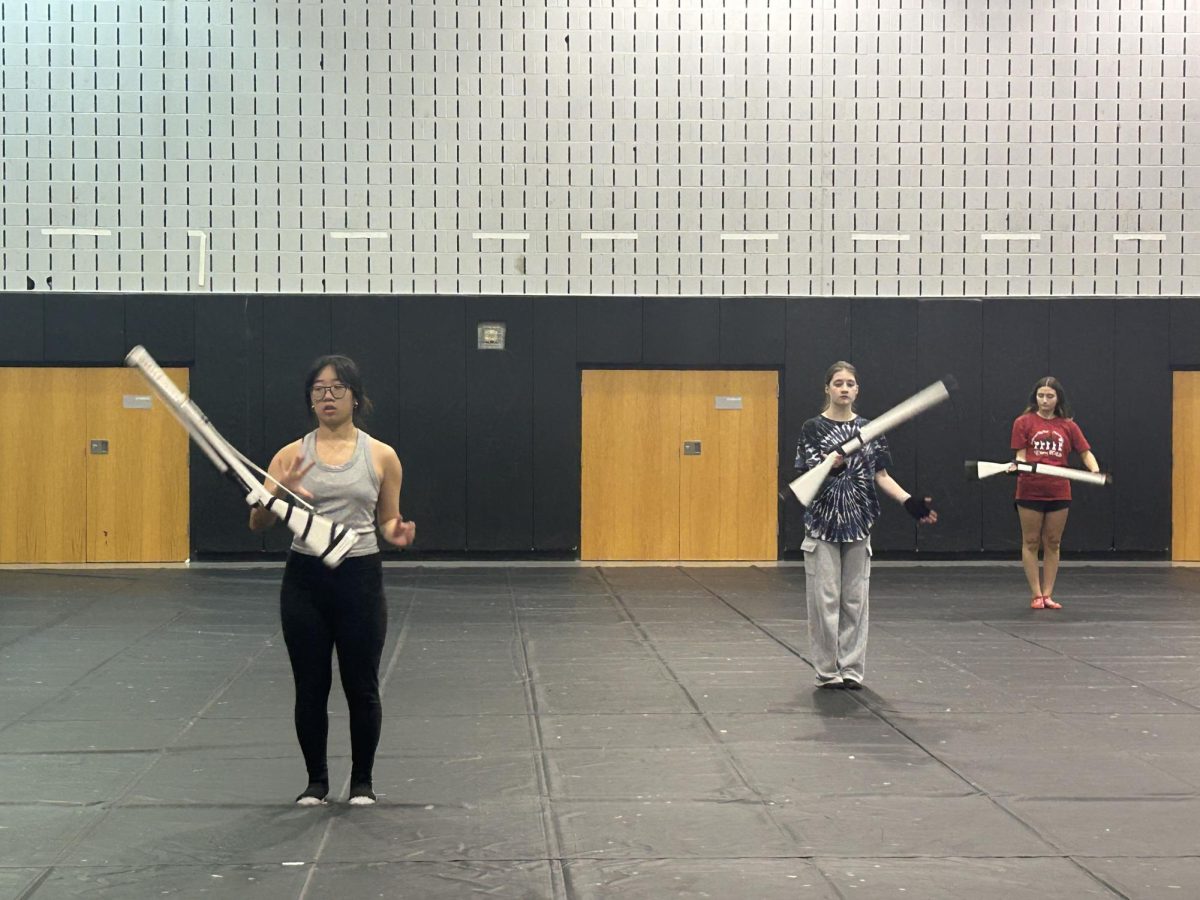
Creating Friendships . . . Working together, Sophomore Sydney Bui (left) and Senior Rose Waldron (right) practice throwing rifles during Color Guard practice. By continuing to support and encourage each other, Color Guard makes a welcoming environment for students.
More to Discover


About the Contributor
Anushka Abraham, Staff Writer