

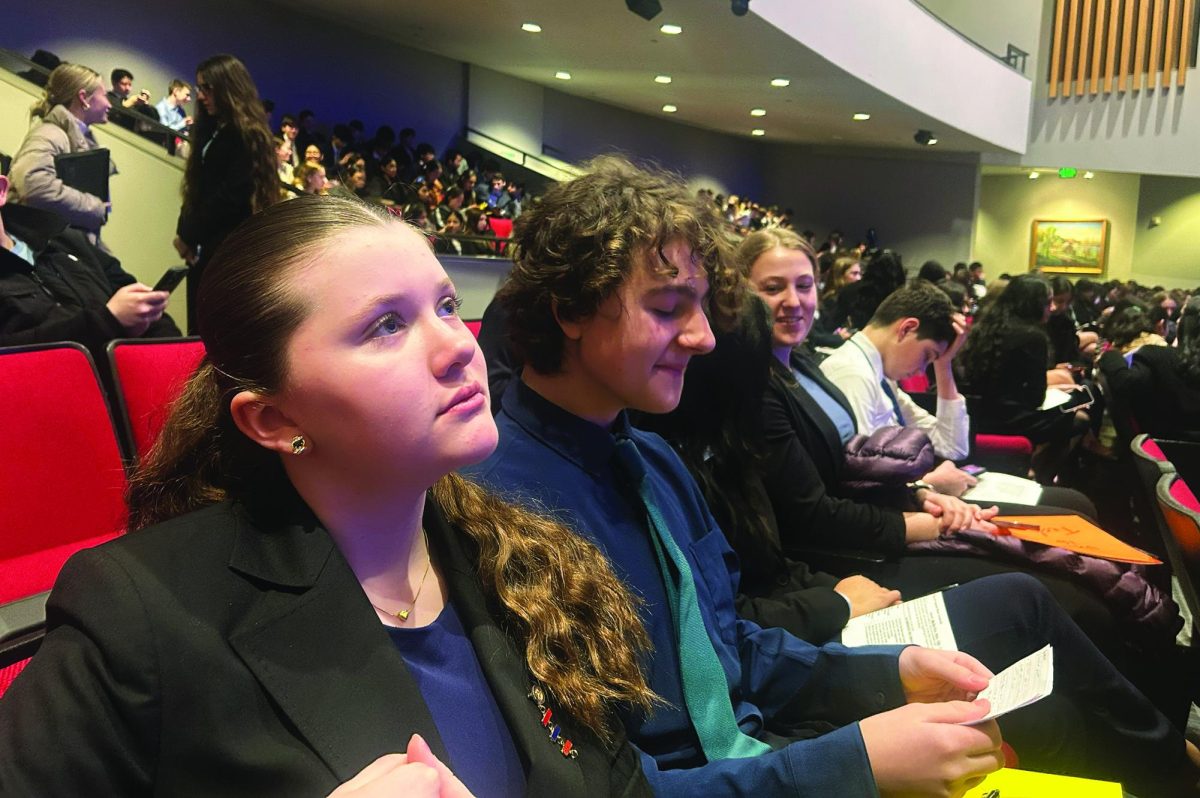
Learning life lessons and enjoying a sense of community, science fair students competed at the Pennsylvania Junior Academy of Science (PJAS) fair on February 21.
Students have the opportunity to participate in an extracurricular science fair competition held at the high school, with many different schools around the county joining together to compete for the chance to advance to the state competition at Penn State.
According to Science Fair advisor Karen Wolfe, students are judged based on a “rubric of excellence” and not against their fellow competitors.
The first part of the PJAS competition at the high school allows students to compete alongside others in their category, with scores determined by volunteer judges with scientific backgrounds.
For freshman Zoe Mamzic, a major goal is to advance to the state competition at Penn State, which requires a first place on a rubric at PJAS, where students will then spend three days overnight prepping and presenting for the next round while exploring campus.
“I really want to go to Penn State,” Mamzic said. “It was a great experience last year. I just want to do it again.”
After spending time practicing and performing presentations, students take away life lessons and work on important skills such as public speaking.
“It’s really helped me with public speaking,” freshman Catherine Schindele said. “Not only in just getting up and talking about science, but also in other aspects like talking in front of a class and singing in choir.”
Students brainstorm their experiments in September, to finally compete in February after five months.
According to Wolfe, the process is not only about the experimentation and research they conduct, but also about the skills they acquire, such as time management.
According to the students, they dedicate many hours to preparing for the fair, formulating questions to guide their experiments.
Spending many hours over the school year researching, hypothesizing and conducting experiments, they learn to balance science fair with school and home life.
Not only is there the experiment, but for Schindele, a large aspect is getting the project “inside and out” before competition day.
The students find it hard to learn this confidence, so they find comfort in the connections they make during the preparation for the fair.
“This club has really helped me meet people that I don’t think I would normally meet,” Schindele said. “We just have a lot of fun together.”
As an extracurricular activity that requires unnecessary work, students don’t need to return year after year, yet some still do.
Mamzic said that one of the reasons she returned this year to compete was the club’s social aspect and the fun it brought her.
A major setback for Schindele has been procrastination, which she is working to overcome as she returns to the fair.
“Honestly, I am very proud of myself for how little I procrastinated this year,” Schindele said.
For Wolfe, her least favorite part of preparing for the science fair is students struggling to meet the “hard deadlines” required to participate in the competition.
Since the science fair isn’t a class, the deadlines are much more realistic and there is no room for leniency.
Some students may look forward to participating in a different upcoming fair, the Montgomery County Science and Research Competition (MCSRC), and competing against others in their category, rather than using the PJAS rubric system.
If students receive a first, second or third place at the MCSRC, they can move on to the state competition at Delaware Valley Science Fair (DVSF).
“They do is they take all the first-place winners in each grade level across the categories, and they judge them against each other,” Wolfe said. “They look to see who’s the first, second and third place of those, and those kids go to the International Science Fair.”
Yearlong preparation leads up to Science Fair competition
After months of preparation, science fair students follow the experimental process and practice public speaking as they competed at the high school on February 21 against students from other districts.
More to Discover


About the Contributor
Jasmine Bilotti, Staff Writer